Drone Services North East

Offshore & Renewable Energy

certified · Fully insured · CAA-compliant

We deliver specialised drone services for offshore platforms, wind farms, and renewable energy infrastructure — combining CAA-compliant aerial operations with deep understanding of marine environments, HSE protocols, and energy-sector workflows. Our solutions support inspection, monitoring, and documentation needs in some of the most challenging operational settings.


All missions are led by an offshore-qualified HSE advisor with extensive experience in oil & gas and renewables. We provide safe, efficient alternatives to rope access and vessel-based surveys — reducing downtime, minimising personnel exposure to risk, and delivering high-quality visual data for maintenance planning, compliance reporting, and asset integrity management.

Specialist Drone Services for Offshore & Renewable Energy

Our Offshore & Renewable Energy service delivers safe, efficient aerial inspection and monitoring solutions for wind farms, oil and gas platforms, substations, and marine infrastructure — reducing reliance on rope access, vessel mobilisation, and personnel working at height in high-risk environments.

Led by an offshore-qualified HSE advisor with extensive energy-sector experience, we combine CAA-compliant drone operations with deep understanding of marine logistics, safety protocols, and asset integrity requirements. Every mission is planned to minimise operational disruption while maximising data quality and safety.

Our approach integrates: Offshore-certified pilots and equipment, HSE-driven risk assessments, corrosion and defect-focused visual analysis, thermal imaging for electrical and blade inspections, and reporting aligned with recognised energy-sector standards, including OGP and G+ guidance — delivering actionable insights, not just aerial photos.

From routine turbine blade checks to emergency flare stack assessments, our service supports maintenance planning, regulatory compliance, insurance documentation, and capital expenditure decisions across the energy sector.

Why Specialised Offshore Drone Services Matter

HSE-Led Operations

Unlike general drone operators, our team includes an offshore HSE advisor who understands permit-to-work systems, marine safety, dropped object prevention, and energy-sector risk management — ensuring strong compliance and minimal operational impact.

Reduced Downtime & Cost

Eliminate costly vessel charters, crane hires, or platform shutdowns. Inspections can often be completed during normal operations without interrupting production or requiring additional safety resources.

Enhanced Safety

Remove personnel from height, confined spaces, or live electrical environments. Drone inspections significantly reduce exposure to high-risk activities while maintaining or improving data quality.

Energy-Sector Reporting Standards

Deliverables follow recognised industry best practice, including G+ and OGP guidance, with defect classification, severity grading, location mapping, and recommendations suitable for maintenance work packs, regulatory submissions, and insurance claims.

Marine-Ready Equipment & Teams

We use saltwater-resistant drones, redundant systems, and offshore-trained crews capable of operating from vessels, helidecks, or coastal bases — with full contingency planning for harsh marine conditions.

What This Service Delivers

Wind Turbine Blade Inspections

High-resolution visual and optional thermal inspection of rotor blades to identify cracks, erosion, lightning damage, and coating failures — compliant with G+ guidelines.

Inspection coverage:

  • Leading and trailing edge damage
  • Tip and root section defects
  • Lightning receptor integrity
  • Surface delamination and paint loss
  • Thermal anomalies indicating internal defects
  • Blade alignment and pitch verification

Deliverables: Annotated defect register with GPS/blade position, severity classification, photographic evidence, repair recommendations, and integration with CMMS systems.

Applications: Condition-based maintenance, warranty claims, insurance renewals, pre-acquisition due diligence, regulatory compliance.

Offshore Platform & Asset Surveys

Comprehensive visual assessment of jackets, topsides, flare stacks, cranes, and process equipment without rope access or vessel support.

Survey capabilities:

  • Corrosion and coating degradation mapping
  • Structural member integrity: braces, nodes, and welds
  • Flare stack and chimney condition
  • Cable tray and electrical cabinet overview
  • Access platform and grating condition
  • Emergency equipment visibility checks

Safety advantages: No hot work permits, no confined space entry, no personnel over water. Full dropped object prevention compliance.

Reporting: Defect logs with location tagging, severity ratings, recommended actions, and supporting imagery — formatted for SAP or Maximo integration.

Applications: Asset integrity management, statutory inspection support, shutdown planning, insurance assessments, and HSE compliance documentation.

Substation & Electrical Infrastructure

Thermal and visual inspection of live electrical assets to identify overheating, vegetation encroachment, and physical damage — conducted safely from a distance.

Inspection scope:

  • Transformer and bushing thermal anomalies
  • Switchgear and connector hotspots
  • Insulator contamination or cracking
  • Cable termination integrity
  • Perimeter security and access route checks
  • Solar farm DC string performance via thermal inspection

Safety compliance: All flights maintain safe clearance distances from live conductors per ENA/NG standards. No de-energisation required.

Deliverables: Thermal anomaly report with temperature differentials, priority action list, annotated imagery, and compliance statement.

Applications: Predictive maintenance, regulatory compliance, insurance risk assessment, outage planning, and renewable energy performance verification.

Marine & Coastal Infrastructure

Inspection of jetties, breakwaters, pipelines, and coastal defences using marine-capable drones with extended range and salt-resistant components.

Capabilities include:

  • Quay wall and sheet pile condition
  • Scour and seabed erosion assessment
  • Pipeline above-ground section integrity
  • Mooring dolphin and fender condition
  • Tidal energy device structural checks
  • Coastal erosion and habitat monitoring

Operational flexibility: Launch from shore, vessel, or platform. Real-time video relay to on-site engineers. Tide and weather window optimisation.

Reporting: Geotagged defect maps, comparative analysis against previous surveys, volumetric change estimates where applicable, and environmental compliance notes.

Applications: Port authority asset management, environmental monitoring, decommissioning surveys, regulatory compliance, and insurance documentation.

Emergency & Ad-Hoc Response

Rapid deployment for post-storm damage assessment, fire incident review, or unplanned outages — often within 24 hours.

Response services:

  • Post-extreme weather damage surveys
  • Fire or explosion site reconnaissance
  • Leak or spill perimeter documentation
  • Security breach or vandalism assessment
  • Search support for non-life-critical scenarios
  • Regulatory incident evidence capture

Deployment model: Pre-approved emergency call-off agreements, 24/7 contact line, rapid mobilisation from regional hubs, full incident logging, and chain-of-custody documentation.

Deliverables: Preliminary findings within 4 hours, full report within 24–48 hours, and raw data archive for investigation teams.

Applications: Incident investigation, insurance claims, regulatory reporting, operational recovery planning, and stakeholder communication.

How Inspections Work

From initial briefing through to final reporting, every inspection follows a structured methodology designed to deliver safe, compliant visual assessments with actionable defect identification.

1
2
3
4
5
1

Asset Review & Requirements

We establish inspection scope, asset access constraints, and reporting requirements — ensuring deliverables meet your maintenance planning and compliance objectives.

This stage includes:

Asset type and location confirmation, inspection objectives and defect priorities, required detail level and severity classification, access arrangements and safety protocols, reporting format and integration requirements.

2

Risk Assessment & Planning

Detailed safety planning ensures compliant operations appropriate to the site environment — with full integration into existing safety management systems where applicable.

Planning considerations:

Site-specific risk assessment and method statement, exclusion zone definition and access coordination, weather windows and operational constraints, equipment selection for environment and altitude, communication protocols with facility management.

3

Visual & Thermal Data Capture

High-resolution visual and thermal imagery captured from controlled perspectives — providing comprehensive asset coverage without personnel working at height.

Capture standards:

Pre-inspection safety briefing and site coordination, systematic coverage ensuring all asset areas documented, visual imagery at multiple scales for context and detail, thermal imaging where defects require temperature analysis, real-time quality verification before leaving site.

4

Defect Analysis & Classification

Captured imagery reviewed systematically to identify defects, assess severity, and provide actionable recommendations aligned with maintenance priorities.

Analysis process:

Systematic review identifying visible defects and anomalies, severity classification (urgent/high/medium/low), defect location mapping and geo-referencing, thermal anomaly interpretation for electrical or insulation issues, remedial recommendations with cost implications.

5

Reporting & Recommendations

Professional inspection reports with annotated imagery, defect registers, and actionable recommendations suitable for maintenance contractors and technical stakeholders.

Deliverables include:

Executive summary with urgent actions flagged, annotated imagery with defects clearly marked, defect register with severity and location data, remedial recommendations and priority actions, methodology statement and compliance documentation.

Typical Applications

Specialist drone inspection and monitoring services for offshore oil & gas, onshore/offshore wind, and marine energy infrastructure — supporting safety, compliance, and asset integrity in demanding environments.

Wind Turbine Blade Inspections

High-resolution visual and thermal blade assessments compliant with G+ guidelines — identifying cracks, erosion, lightning damage, and coating failures without rope access.

Offshore Platform Surveys

Jacket, topsides, and flare stack inspections from vessel or platform — reducing need for crane hires, scaffolding, or personnel over water.

Substation & Electrical Inspections

Thermal imaging of live transformers, switchgear, and conductors — identifying hotspots and vegetation encroachment without de-energisation or close approach.

Marine & Coastal Infrastructure

Quay walls, breakwaters, pipelines, and tidal energy devices inspected from shore or vessel — supporting port authority asset management and environmental monitoring.

Solar Farm Monitoring

Thermal drone surveys to detect faulty PV cells, string failures, and performance anomalies across utility-scale solar installations.

Emergency Response & Incident Review

Rapid deployment for post-storm damage, fire scenes, or unplanned outages — delivering preliminary findings within hours for insurance and regulatory reporting.

Corrosion & Coating Assessment

Visual mapping of corrosion, pitting, and coating degradation on steel structures — supporting NDT targeting and maintenance prioritisation.

Regulatory & Compliance Documentation

Inspection reports aligned with OGP, IMCA, G+, and ENA standards — suitable for HSE submissions, statutory inspections, and audit evidence.

Pre-Shutdown Planning

Comprehensive asset condition baseline before turnarounds — reducing scope uncertainty and minimising critical path delays.

Dropped Object Prevention Support

Aerial verification of grating, handrails, and equipment security — enhancing safety during high-risk offshore operations.

Tidal & Wave Energy Inspection

Condition monitoring of submerged and surface-level marine energy converters in challenging coastal environments.

As-Built Verification

Post-installation verification of offshore structures, cable routes, and substations against design models and permit conditions.

Maintenance Work Pack Support

Defect registers with geotagged imagery and severity ratings — ready for direct import into SAP, Maximo, or CMMS systems.

Insurance & Warranty Claims

Independent, time-stamped visual evidence for turbine blade damage, storm impact, or equipment failure — accelerating claim resolution.

Cable Route & Pipeline Surveys

Above-ground section verification for subsea export cables and pipelines — identifying exposure, scour, or third-party interference.

HSE-Led Operational Integration

Full alignment with permit-to-work, SIMOPS, and site safety rules — led by an offshore-qualified HSE advisor from briefing to delivery.

Why Specialised Offshore Drone Inspections Matter

Many drone providers offer generic aerial photos with no understanding of marine environments, energy-sector standards, or HSE protocols. We deliver inspection-grade data — captured, analysed, and reported to G+, OGP, and IMCA standards by offshore-qualified professionals who prioritise safety and asset integrity.

What Sets Us Apart

  • HSE-led operations, not just flying — integrated with your permit-to-work, SIMOPS, and dropped object prevention systems
  • Energy-sector defect classification aligned with G+ blade standards, corrosion mapping, and electrical thermal protocols
  • Marine-ready equipment & teams with saltwater-resistant drones, vessel deployment experience, and offshore survival training
  • Regulatory-compliant reporting suitable for HSE submissions, insurance claims, and statutory inspections
  • No personnel over water or at height — reducing risk while improving data quality and coverage

Who This Service Is For

Offshore installation managers, wind farm operators, HSE advisors, asset integrity engineers, and maintenance coordinators who need reliable, actionable inspection data — not hobbyists with consumer drones unaware of marine risks.

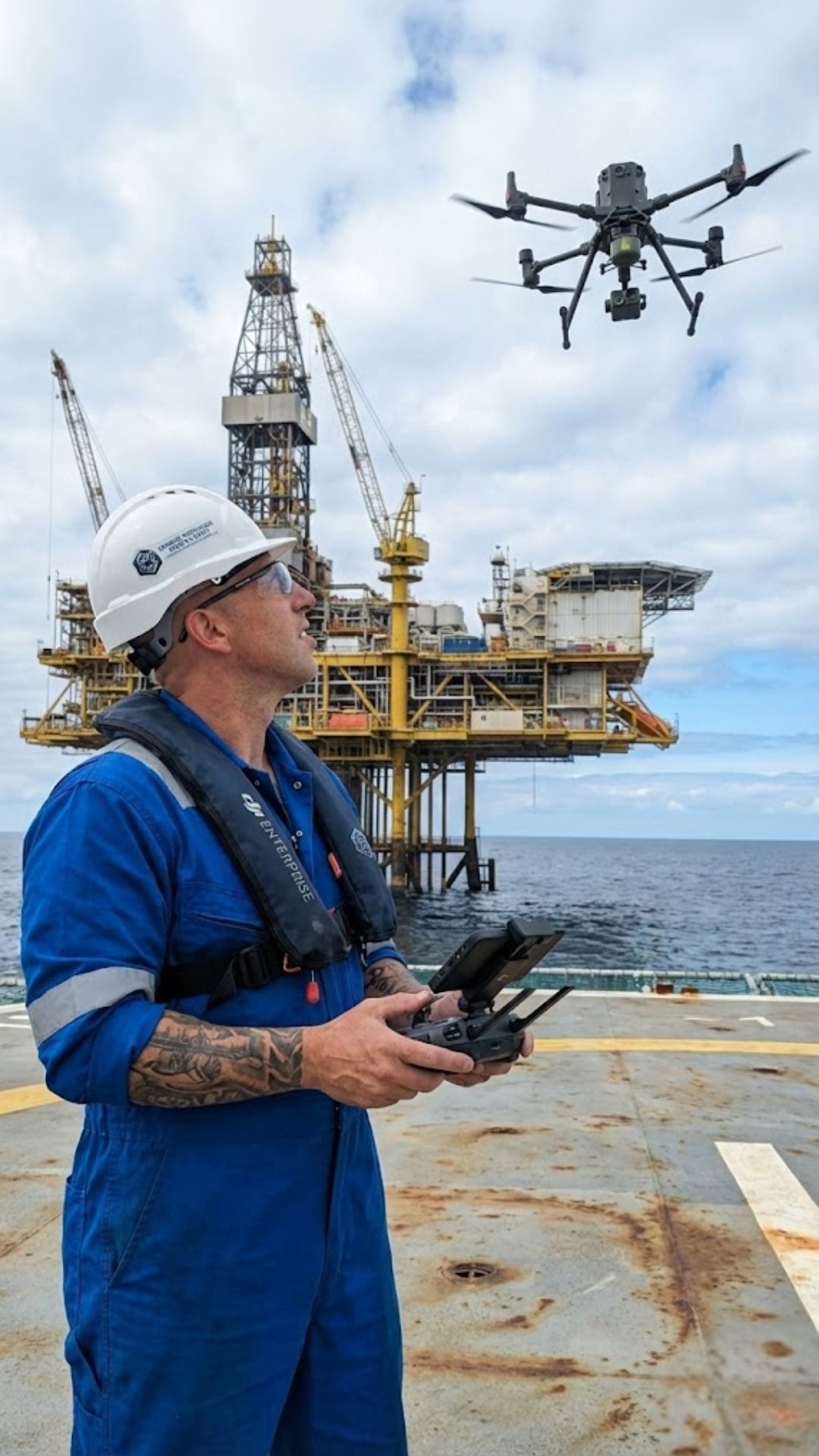
Offshore drone inspection of wind turbine and platform conducted by HSE-qualified team in marine environment

Frequently Asked Questions

Your questions about offshore inspections, wind farm assessments, and marine operations — answered.

How is your offshore service different from standard drone inspections?
We’re not just pilots — we’re energy-sector specialists. Every mission is led by an offshore-qualified HSE advisor, uses marine-ready equipment, and follows G+, OGP, and IMCA standards — delivering inspection-grade data, not generic aerial photos.
Can you inspect assets without personnel over water or at height?
Yes. Our drones eliminate the need for rope access, scaffolding, or vessel-based surveys. We safely inspect flare stacks, turbine blades, and platform structures — with zero personnel over water or at height, reducing risk and downtime.
Do you comply with G+ guidelines for wind turbine inspections?
Fully. Our blade inspections follow G+ best practices:
• High-resolution visual + thermal imaging
• Leading/trailing edge defect mapping
• Lightning receptor integrity checks
• Severity classification (critical/high/medium)
• Blade position tagging and repair recommendations
Reports are formatted for CMMS integration (SAP, Maximo).
Can you operate from vessels or offshore platforms?
Yes. Our team is trained for:
• Vessel-based launches (CTVs, PSVs)
• Helideck/platform operations
• Coastal base deployments
We use saltwater-resistant drones with redundant systems and full contingency planning for harsh marine conditions.
How do you handle permit-to-work and SIMOPS?
We integrate fully into your safety systems:
• Pre-mission PTW/SIMOPS coordination
• Dropped object prevention compliance
• Exclusion zone management
• Real-time communication with OIM/CTV crew
All flights are supervised by our offshore HSE advisor.
What happens if weather or sea conditions prevent flying?
We monitor marine forecasts and sea state in real-time. If conditions are unsafe, we:
• Reschedule within 24–48 hours
• Adjust flight windows to match tidal/weather cycles
• Provide alternative deployment options (e.g., coastal vs. vessel)
No extra cost — safety is non-negotiable.
Can you inspect live electrical assets (substations, transformers)?
Yes — safely and compliantly:
• Maintain ENA/NG safe clearance distances
• Use thermal imaging for hotspot detection
• No de-energisation required
• Full coordination with network operators
Ideal for predictive maintenance and outage planning.
How quickly can you respond to emergency incidents?
We offer 24/7 emergency call-off:
• Preliminary findings within 4–6 hours
• Full report within 24–48 hours
• Rapid mobilisation from regional hubs
Used for post-storm damage, fire scenes, and unplanned outages.
Do your reports meet regulatory and insurance requirements?
Yes. Deliverables include:
• Methodology statements aligned with OGP/IMCA
• Defect registers with geotagged imagery
• Severity classifications and repair recommendations
• Chain-of-custody documentation for incident evidence
Accepted by HSE, insurers, and certification bodies.
Can you support pre-shutdown or turnaround planning?
Absolutely. We provide:
• Comprehensive asset condition baselines
• Defect mapping for work pack scoping
• Access route verification
• Risk identification for high-risk tasks
This reduces critical path uncertainty and minimises shutdown duration.
Ready to Get Started?

Discuss Your Offshore Inspection Needs

We'll advise on the most effective approach for your offshore or renewable energy asset — from HSE-compliant mission planning and marine deployment through to G+ or OGP-aligned reporting.

Same-day response · No-obligation consultation

Safety-Led
£10M Insured
CAA Compliant
HSE Experienced